
ASDT Corporation
Security · drone detection
Real-time threat detection and monitoring app
Deployed in more than 500 portable detection units worldwide, at institutional events, mass gatherings and defence operations: it runs in hostile terrain without connectivity, with in-house offline maps and remote updates.
+500
portable detection units deployed worldwide
Real time
threat detection and monitoring in the field
Remote
fleet-wide updates without visiting each installation
Client
ASDT CorporationIndustry
Security · drone detection
Services
Technologies
Overview
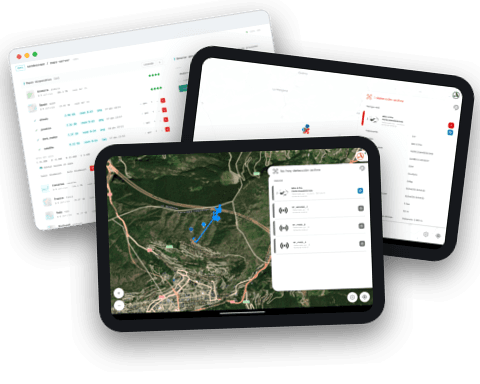
Complete SendeScope ecosystem for ASDT Corporation: Android tablet app for real-time drone detection and tracking, with in-house offline map server and APK distribution server. It turned a third-party-dependent system into a self-sufficient product, deployable autonomously. Three components: Android app (GPS and sectoral RF detection on offline maps, model identification, alarm zones, multi-language), map server with tiles for 13 countries in four styles, and APK server with CI/CD on GitLab.
Context
The client
ASDT Corporation operates in drone detection and tracking (counter-UAS). SendeScope combines physical detectors —GPS and multi-antenna sectoral RF— with a tablet app that centralizes detections in real time, deployable in field cases.
The challenge
Strong dependence on an external team and third parties: it was not possible to publish versions without the other team's certificate, there was no control over the maps (a single style, no traceability), no CI/CD or APK version management, and tablet updates were manual. Plus stability problems —crashes during tracking, lost detections when changing location, memory leaks—. They needed in-house, reliable, self-sufficient infrastructure, and to raise the quality of the legacy system.
The solution
How we solved it
- 01
Independence and in-house infrastructure
Signing keystore integrated into GitLab within the build flow, eliminating dependence on the external certificate. ASDT builds, signs, publishes and deploys new versions autonomously. Docker-based infrastructure with persistent volumes and production-ready configuration.
- 02
In-house map server
Map server built from scratch with Node.js + Nginx on Docker: on-demand tile generation from an admin panel with real-time progress, four styles (Voyager, Positron, Dark Matter, Satellite), coverage for 13 countries —expandable without touching code—, automatic thumbnails and access logging. Nginx as reverse proxy optimized for multi-GB files with direct-to-disk transfer.
- 03
Update server and CI/CD
APK server on Docker with authenticated download for tablets and a panel with version listing, statistics and uploads. Integrated with GitLab: version tags, synchronized release notes and a pipeline that, on creating a tag, builds the APK and makes it available with automatic versionCode increment. New version deployment in less than a minute.
- 04
App improvements, stability and quality
Renewed map system with offline rendering in MBTiles (one file per country and style), visual download, automatic retries and zoom limit based on coverage. In-app update, distinction between RF detections (multi-antenna directional cones) and serial-number detections (model icon: Autel, DJI, FPV), and four languages with real-time switching. Crashes during tracking, memory leaks and detection losses fixed.
What changed
Results
Full client autonomy: build, sign, publish and deploy new versions without dependence on the previous development team or its certificate.
In-house, controlled infrastructure: maps and updates deployed with Docker, production-ready and fully traceable.
Deployment in less than a minute: a new version reaches the tablets via the GitLab CI/CD pipeline, compared to the previous manual process.
Reliable map system: four styles, coverage for 13 countries and complete download management, replacing a system without control or traceability.
Greater operational reliability: after resolving unexpected crashes, memory leaks and detection losses that affected field use.
Foundation ready to scale: new countries and styles without touching code and architecture ready for the new v2 of communication.
Remote updates across the fleet: each unit used to be updated on site, installation by installation; a new version now reaches every unit without travel.
Proven where failure is not an option: institutional events, mass gatherings and defence operations, in hostile terrain and without coverage.
What clients say about the project
Voice of the client
“Estamos trabajando con Guille y Leo y la verdad es que estamos muy contentos con el resultado. Son profesionales, cumplen con los plazos y nos lo ponen todo muy fácil. Gente así cuesta de encontrar”
Roger Rodriguez
Director de Proyecto en ASDT
More cases.
More projects by the same team.