Sic4Change · Nut4Health
Third sector · social innovation and health
Data platform for the fight against malnutrition
Thousands of cases followed across hundreds of health centres in Spain and Mauritania, with full traceability of every child from detection to follow-up.
Thousands of cases
followed across hundreds of health centres
2 countries
Spain and Mauritania
Full traceability
of every case, from detection to follow-up
Client
Sic4Change · Nut4HealthIndustry
Third sector · social innovation and health
Services
Technologies
Overview
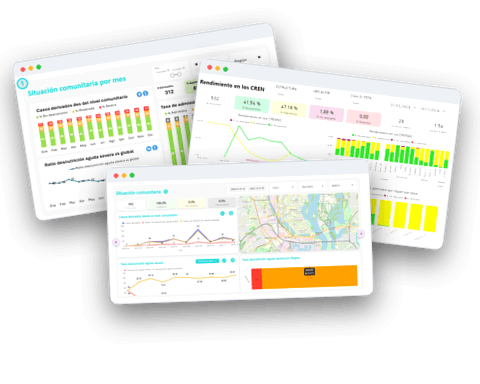
Nut4Health's “Data Platform” for Sic4Change: a complete analytics infrastructure that turns operational records into evidence-based, actionable information. Four integrated components: Python ETL from Firebase, a MySQL Data Warehouse with an analytical model, an authenticated REST API that exposes the data without direct database access, and two complementary visualisations —Power BI and an in-house Flutter dashboard— embedded in the website with permissions and roles.
Context
The client
Sic4Change runs Nut4Health, a programme for the detection, treatment and prevention of acute child malnutrition in vulnerable contexts, deployed in Mauritania. Its operation relies on two mobile apps: a screening app, with which agents and volunteers register cases in the community, and a health-centre app that manages the cases treated —clinical status, measurements, medication and follow-up—. Key programme data, but trapped in operational databases with no analytical model.
The challenge
Information stored in Firebase, optimised for the apps' operation rather than for analysis. Data scattered across two applications with structures designed for field recording. With no unified model or structured store, managers depended on manual extractions. All within a tight third-sector budget that ruled out licence-heavy BI and required an efficient, sustainable architecture that could scale to new countries.
The solution
How we solved it
- 01
Automated ETL processes
A Python ETL that every night collects the data from both apps in Firebase, cleans it and adapts it to the analytical model before loading it into the warehouse. Unattended execution: every morning the previous day's data is ready.
- 02
Data Warehouse with an analytical model
A simplified analytical model in MySQL: dimensions (child, guardian, location) and facts for the two operational levels —community (contracts) and centres (cases and visits)—. It allows analysing both recruitment in the field and clinical progress in the centres.
- 03
REST API for data access
A REST API with token authentication and specialised endpoints (cases, contracts, visits, locations, GeoJSON) that isolates the visualisations from the warehouse. Every endpoint accepts filters by country, region, province, centre type, sex, malnutrition level or date.
- 04
Two complementary BI solutions
After comparing Looker Studio, Power BI, Tableau and Qlik on cost, flexibility and access control, we built two visualisations on the same API. Power BI for agile exploration. An in-house cross-platform Flutter dashboard for a tailored experience on any device, with no licence cost and fully controlled by the organisation. Both organised in four blocks aligned with UNICEF indicators.
- 05
Web integration with roles and permissions
Embedded in the organisation's website with permissions and roles that determine what each profile sees —essential given the confidentiality of health data—. Dynamic consumption: the visualisations feed in real time from the API with filtered, interactive queries.
What changed
Results
End-to-end data platform: from information scattered across operational databases to a complete analytics ecosystem that turns raw data into actionable information.
Data always up to date, no manual effort: the ETL processes run automatically every day, guaranteeing clean, current information without the team's intervention.
Secure, decoupled access: an authenticated, filterable REST API that opens the data to multiple visualisation tools without exposing the database.
Two visualisation paths: Power BI and an in-house cross-platform Flutter dashboard, combining the flexibility of an established tool with a tailored, licence-free experience.
Evidence-based decisions: dashboards that put admission, recovery, dropout and mortality rates, treatment duration and territorial coverage within reach.
Sustainable, affordable solution: an efficient architecture deployed on the organisation's own infrastructure that avoids high licence costs —key for a third-sector organisation.
Full traceability of every case: every child is followed from detection to discharge, with the information from both field apps unified.
An operation geared to reducing risk: managers see sooner where to act and run the programmes on data, to reduce the risk of acute malnutrition and child mortality.
More cases.
More projects by the same team.